
Insights
Beyond the X’s and O’s of the Game — Coach Blog Series, Part 4

Coaching at the collegiate level goes beyond just game strategy. This series explores the administrative side of running a successful program, with practical insights from Coach Mac, a former women’s volleyball coach.
Have a topic you’d like us to explore? We welcome and encourage you to reach out with suggestions for future sessions: [email protected]
Tracking Countable Hours: CARA vs. VARA
As much as coaches want their athletes to practice and work out all the time, collegiate athletes are not just athletes, they are students first. Their main priority is earning a degree, and that’s why the NCAA has put regulations in place that limit the amount of CARA, or “countable athletically related activities,” that student-athletes can participate in. Activities included under CARA are practices, skill sessions, film sessions, team meetings, workouts, or any mandatory activity where coaches are present. The NCAA sets hour limitations depending on whether a team is in its championship segment or non-championship segment. A championship segment is what most people call “in season,” while a non-championship segment is “out of season.” While these segments may look different for each sport, the same general rules apply, with the exception of football, which has some additional specific rules.
When in season, a team is allowed to participate in up to four hours of CARA per day and 20 hours total per week. This is calculated over a full seven-day week, and teams are required to have at least one day off each week. Coaches are responsible for entering their daily and weekly hours to their compliance director, who ensures the team stays within regulations. Every college handles submissions differently, but Spry makes this process easy for coaches, student-athletes, and compliance administrators. Instead of scrambling at the end of the week, coaches can log activities as they go, which helps with staying organized and avoiding surprises. Having everything in one place gives a much clearer picture of how close the team is to daily and weekly limits.
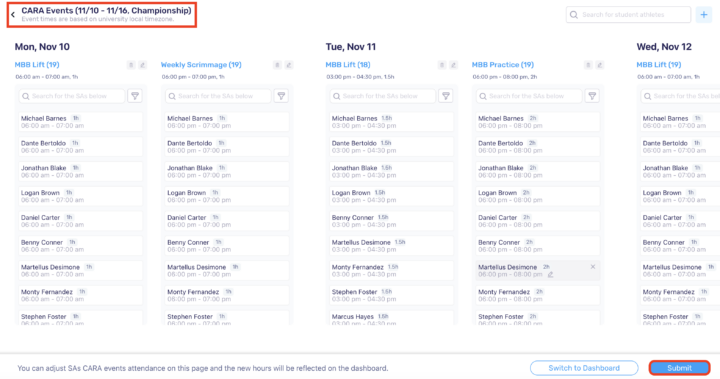
One specific way Spry helps with the management of these hours is through a unique tool called the CARA Assistant. This feature allows coaches to review CARA events and then submit the hours directly to compliance. This process streamlines communication and makes sure everyone is on the same page and following regulations.
Out-of-season regulations differ by comparison. In the non-championship segment, student-athletes are allowed to participate for up to eight hours per week, with only four of those hours being for skill instruction. The remaining four hours can be used for workouts, team meetings, or film sessions. Teams in their out-of-season segment are required to have two days off per week. Additionally, during the off-season, all teams must complete any workouts and practices one week prior to final examinations. While in-season and out-of-season limitations are fairly straightforward, preseason practices are different. For most sports, there are no daily or weekly CARA limits during preseason. Preseason is defined as the period of practice prior to the start of classes or the first game, whichever comes first.
While any activity required by a coach or staff member falls under CARA, there are also activities called VARA or “voluntary athletically related activities.” For an activity to be considered VARA, the student-athlete cannot be required to report back to a coach or staff member. The student-athlete must initiate and request the activity, and no participation can be recorded for the purpose of reporting back to coaches. Coaches also cannot penalize student-athletes for choosing not to participate. Coaches and student-athletes should check with their athletic department’s compliance director to determine if any VARA reporting is required.
There are several specific exceptions to CARA, so coaches should be familiar with the rules for their sport or reach out to their compliance director with any questions. It is important for coaches and staff members to know any regulations for their sport as any violation of the regulations could be hurtful to the team, including hours cut or changed due to the violations. Coaches should also strive to be as accurate as possible when reporting hours, since student-athletes are asked to confirm the reported daily and weekly totals.
CARA regulations are not meant to hurt or limit a program, they are designed to help provide balance for student-athletes. As coaches, we want to see student-athletes succeed on the court, field, or track, but we also want them to succeed as students and as people. That means giving them the time and space to do so. Ultimately, CARA and VARA exist in the best interest of the student-athlete, and coaches should always aim to support that.
*All information was fact checked using the 2025-2026 NCAA Division I and II Manual.
Related Insights