New York, NY — April 21, 2026 Spry, the leading all-in-one athletics management platform for collegiate athletic departments, has welcomed Farrah Manthei to the team. Manthei will play a key role in advancing Spry’s mission to simplify operations, reduce costs, and better support athletic administrators, coaches, and student-athletes nationwide.

Manthei brings extensive experience as a tenured collegiate administrator with direct insight on internal operational needs, and with a proven track record of supporting athletic departments by driving operational excellence. Her addition to the team reinforces Spry’s commitment to partnering closely with institutions to help them navigate the increasing complexity of modern college athletics.

“Farrah understands the challenges athletic departments encounter daily,” said Lyle Adams, CEO of Spry. “Her experience and perspective will play a critical role as we continue building a platform designed to support today’s administrators, coaches, and student-athletes. At Spry, we go beyond software and work alongside our partners to help them achieve meaningful success.”

Manthei’s decision to join Spry was driven by the company’s customer-first approach and its ability to deliver meaningful value to athletic departments of all sizes.

“I want to thank Lyle Adams and the Spry team for this opportunity,” said Manthei. “Spry is addressing critical operational challenges for athletic administrators with an intuitive, cost effective, all in one platform that streamlines day to day operations, reduces administrative burden, and drives greater efficiency across departments. As budgets tighten, our focus is on helping partners operate more effectively while delivering measurable cost savings to the bottom line. I look forward to building meaningful partnerships and providing solutions that create lasting impact.”

Spry’s platform streamlines critical athletic department functions, including recruiting, compliance, communication, and document management, into a single, unified system. This centralized approach eliminates the need for multiple disconnected tools, reducing inefficiencies and saving departments both time and money. As seen with institutions like Rivier University Athletics and SUNY Morrisville Athletics, departments that adopt Spry experience improved organization, streamlined workflows, and measurable time savings.

Unlike legacy providers that are often overpriced and slow to respond to customer needs, Spry is built around a partnership model, working alongside athletic departments to continuously improve workflows, enhance communication, and deliver long-term value.

The addition of Manthei comes at a time of rapid growth for Spry, as more institutions seek modern, flexible solutions to manage the evolving demands of collegiate athletics. With a growing customer base and a strong focus on customer success, Spry is well-positioned to become the industry standard for athletic department operations.

Coaching at the collegiate level goes beyond just game strategy. This series explores the administrative side of running a successful program, with practical insights from Coach Mac, a former women’s volleyball coach.

Have a topic you’d like us to explore? We welcome and encourage you to reach out with suggestions for future sessions: [email protected]

Recruiting

Recruiting for collegiate coaches is one of the hardest—and best—parts of the job. You get to personally handpick the individuals who will become part of your team, which is both exciting and a little intimidating. Coaches should always double-check their specific recruiting calendar based on their NCAA division and sport to make sure they’re recruiting at the appropriate times of the year. With the number of emails coaches send and players they communicate with, it can be difficult to keep everything organized. You’re often collecting film links, phone numbers, call notes, competition schedules, academic information, and more. There are a variety of platforms available to help with this, and Spry is one that provides tools specifically designed to keep coaches organized.

Within Spry, coaches can create prospective student-athlete (PSA) profiles and keep all relevant information in one place. This can include things like phone numbers, emails, recruiting class, position, height, academic information, video links, and more. Coaches can also upload attachments like transcripts and add notes. From personal experience, I used to keep notes in multiple places—spreadsheets, notebooks, my phone, and even sport-specific databases. Having one centralized location where information can be stored, accessed, and updated by staff helps prevent miscommunication and lost details. Everything is available at your fingertips through the Spry app.

One feature coaches should take advantage of is the ability to send questionnaires to PSAs. These responses can automatically help build out a PSA’s profile. This is especially useful when a PSA reaches out and you’re interested in learning more, you can send the questionnaire to quickly get a general overview before scheduling a call or digging through multiple emails. As busy as collegiate coaches are, efficiency is key.

I’ve personally used Spry while recruiting for my Division II volleyball program, and it played a big role in my process. When a PSA reached out and I was interested in continuing communication, I would first email them to schedule an initial phone call. Then, I would send them the questionnaire I created in Spry. This allowed me to gather all of their information in one place while automatically building their profile. After conversations, evaluations, or visits, I could log notes directly into their profile and document when each interaction took place. I also uploaded transcripts and any other documents they provided. Again, having everything in one place helped me stay organized and ensured that other coaches, staff members, and administrators had access when needed.

This level of documentation is also important for compliance. Compliance directors require records of conversations, evaluations, and visits to ensure coaches are following NCAA recruiting bylaws. Having everything documented in one system makes it much easier if the department is ever audited.

Recruiting can look different depending on the level and sport, but one thing that remains constant: coaches need to document as much as possible. This not only helps with staying compliant but also keeps everything organized when managing a large pool of PSAs. With the volume of communication coaches handle, proper documentation helps keep everyone straight.

As a reminder, coaches should always check with their compliance director or division manual to make sure they’re following NCAA guidelines and bylaws. This includes recruiting calendars, visit rules, and other regulations. At the end of the day, coaches are trying to find the best PSAs for their program’s future, and minimizing potential issues is always in their best interest.


From Rider Athletics

LAWRENCEVILLE, NJ — Rider University Athletics is proud to announce a long-term extension of its partnership with Spry, an athletics management platform designed to simplify operations and empower athletic departments to work more efficiently.

“Spry has continued to show a genuine commitment to understanding our needs and supporting our goals,” said Don Harnum, Rider University Athletic Director. “Their team works closely with us to find solutions that make a real impact on our day-to-day operations. We’re confident that Spry will remain a trusted partner in helping us achieve success and better serve our student-athletes.”

Through this extended partnership, Rider University will continue leveraging Spry to strengthen processes across coaches, staff, and student-athletes while improving visibility and coordination throughout the department. With tools that support large-scale messaging, compliance workflows, and day-to-day operations, Rider is positioned to operate more effectively and keep critical information accessible in real time.

“We’re incredibly excited to continue our partnership with Rider University Athletics,” said Lyle Adams, CEO of Spry. “Their commitment to providing a first-class experience for their student-athletes aligns perfectly with our mission. We look forward to building on the strong foundation we’ve established and continuing to support their team in meaningful ways.”

About Rider Athletics:
Rider Athletics is the athletics department of Rider University, a private university located in Lawrenceville, New Jersey. Rider Athletics sponsors 21 varsity sports and is a full member of the Metro Atlantic Athletic Conference (MAAC). Rider Athletics also sponsors wrestling in the Mid-American Conference (MAC) and field hockey in the Northeast Conference (NEC). For more information, visit www.gobroncs.com. 

Coaching at the collegiate level goes beyond just game strategy. This series explores the administrative side of running a successful program, with practical insights from Coach Mac, a former women’s volleyball coach.

Have a topic you’d like us to explore? We welcome and encourage you to reach out with suggestions for future sessions: [email protected]

Tracking Countable Hours: CARA vs. VARA

As much as coaches want their athletes to practice and work out all the time, collegiate athletes are not just athletes, they are students first. Their main priority is earning a degree, and that’s why the NCAA has put regulations in place that limit the amount of CARA, or “countable athletically related activities,” that student-athletes can participate in. Activities included under CARA are practices, skill sessions, film sessions, team meetings, workouts, or any mandatory activity where coaches are present. The NCAA sets hour limitations depending on whether a team is in its championship segment or non-championship segment. A championship segment is what most people call “in season,” while a non-championship segment is “out of season.” While these segments may look different for each sport, the same general rules apply, with the exception of football, which has some additional specific rules.

When in season, a team is allowed to participate in up to four hours of CARA per day and 20 hours total per week. This is calculated over a full seven-day week, and teams are required to have at least one day off each week. Coaches are responsible for entering their daily and weekly hours to their compliance director, who ensures the team stays within regulations. Every college handles submissions differently, but Spry makes this process easy for coaches, student-athletes, and compliance administrators. Instead of scrambling at the end of the week, coaches can log activities as they go, which helps with staying organized and avoiding surprises. Having everything in one place gives a much clearer picture of how close the team is to daily and weekly limits. 

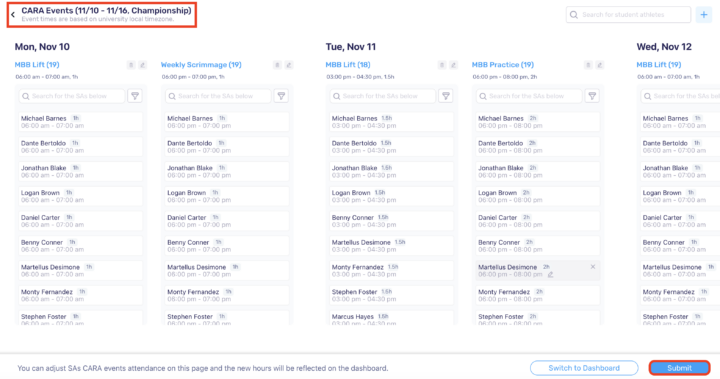
One specific way Spry helps with the management of these hours is through a unique tool called the CARA Assistant. This feature allows coaches to review CARA events and then submit the hours directly to compliance. This process streamlines communication and makes sure everyone is on the same page and following regulations. 


Screenshot at  PM


Out-of-season regulations differ by comparison. In the non-championship segment, student-athletes are allowed to participate for up to eight hours per week, with only four of those hours being for skill instruction. The remaining four hours can be used for workouts, team meetings, or film sessions. Teams in their out-of-season segment are required to have two days off per week. Additionally, during the off-season, all teams must complete any workouts and practices one week prior to final examinations. While in-season and out-of-season limitations are fairly straightforward, preseason practices are different. For most sports, there are no daily or weekly CARA limits during preseason. Preseason is defined as the period of practice prior to the start of classes or the first game, whichever comes first.

While any activity required by a coach or staff member falls under CARA, there are also activities called VARA or “voluntary athletically related activities.” For an activity to be considered VARA, the student-athlete cannot be required to report back to a coach or staff member. The student-athlete must initiate and request the activity, and no participation can be recorded for the purpose of reporting back to coaches. Coaches also cannot penalize student-athletes for choosing not to participate. Coaches and student-athletes should check with their athletic department’s compliance director to determine if any VARA reporting is required.

There are several specific exceptions to CARA, so coaches should be familiar with the rules for their sport or reach out to their compliance director with any questions. It is important for coaches and staff members to know any regulations for their sport as any violation of the regulations could be hurtful to the team, including hours cut or changed due to the violations. Coaches should also strive to be as accurate as possible when reporting hours, since student-athletes are asked to confirm the reported daily and weekly totals.

CARA regulations are not meant to hurt or limit a program, they are designed to help provide balance for student-athletes. As coaches, we want to see student-athletes succeed on the court, field, or track, but we also want them to succeed as students and as people. That means giving them the time and space to do so. Ultimately, CARA and VARA exist in the best interest of the student-athlete, and coaches should always aim to support that.


*All information was fact checked using the 2025-2026 NCAA Division I and II Manual.


From PNWU Athletics

HAMMOND, IN –  Purdue Northwest (PNW) announced a new partnership with Spry, an industry-leading, all-in-one athletics management platform, providing the university with a comprehensive solution to enhance operational efficiency, compliance, and student-athlete engagement across the athletic department.

Through this partnership, PNW will strengthen and modernize its athletic operations by leveraging a centralized platform, bringing recruiting, compliance, communication, paperwork, and roster management together in one intuitive system. Spry was built to help institutions centralize and streamline key administrative functions across its athletic programs, giving staff a more unified and efficient way to manage day-to-day responsibilities. As a result, PNW will operate with greater clarity and control, ultimately enabling the athletic department to enhance the student-athlete experience and drive competitive success.

“We are thrilled to partner with Purdue Northwest,” said Lyle Adams, CEO of Spry. “PNW has a strong commitment to their student-athletes, and we believe the Spry platform will be an invaluable asset in helping them achieve new levels of operational excellence and institutional alignment. This partnership underscores the growing need for integrated software solutions in collegiate athletics, and we look forward to supporting PNW’s mission for years to come.”

“As we looked for ways to be innovative in how we operate, Spry stood out for its feature offering, user experience, and commitment to customer success,” said Courtney Locke, Senior Associate Athletic Director. “We want tools that are built for institutions like ours, and Spry has demonstrated that commitment. Their platform will help us increase efficiency, reduce administrative friction, and ultimately better support our student-athletes, coaches, and staff.”

About Purdue Northwest
Purdue University Northwest is a student-centered university located in Northwest Indiana. A proud member of NCAA Division II and the Great Lakes Intercollegiate Athletic Conference (GLIAC), PNW offers 23 intercollegiate athletic programs dedicated to developing student-athletes academically, athletically, and personally. Rooted in a commitment to educational excellence, leadership development, and community engagement, PNW Athletics empowers student-athletes to achieve success in competition, in the classroom, and beyond.

Coaching at the collegiate level goes beyond just game strategy. This series explores the administrative side of running a successful program, with practical insights from Coach Mac, a former women’s volleyball coach.

Have a topic you’d like us to explore? We welcome and encourage you to reach out with suggestions for future sessions: [email protected]

Team Travel

Team travel can bring different emotions for both coaches and student-athletes. There is always excitement around the competition, but, especially for coaches, team travel can also bring stress. Oftentimes, this is stress surrounding preparation for the competition or game, ensuring the safety of each student-athlete, and making sure all needs are met by the team. Coaches may need to work with and communicate effectively across a large group of people, including student-athletes, staff, and outside companies, which can be challenging to manage. For some teams, you may have someone dedicated to handling all team operations, but for other teams, coaches are the ones creating the itineraries and making sure everything runs smoothly. The biggest aspect of the itinerary is typically meals and hotels.

When you are traveling with anywhere from 5 to 100 student-athletes, booking hotels and organizing team meals can be quite an undertaking. Here are a few important questions I turn to and consider before booking hotels:

  1. How far away from the gym or field would you like to be?
  2. What are the food options around the hotel or venue?
  3. How much can you spend per student-athlete or per room per night?
  4. Are the doors to the rooms interior or exterior?
  5. Does it offer breakfast?
  6. What is the parking situation? Does it cost? Are buses able to park in the parking lot or nearby?

Once you have answered these questions for the program, you can start your search for the right hotel for you. We live in a great world with lots of technology, so you can make quick and easy internet searches for hotels that fit your specific needs. Some colleges might have access to a travel agent or someone who can help compile a list of different hotels. It’s important to use your resources and ask other coaches within the department or the AD what is available for you to use. Coaches should try to call and talk to the hotel sales managers rather than just the front desk agents. While the front desk knows if there are enough rooms available for the team, the sales manager is better suited in helping you get the best rate, especially if you need several rooms. In my experience, they are all very helpful and can make your arrival much smoother. 

Providing proper nutrition on the road is sometimes difficult. You may be in a small town where there aren’t many options. If that’s the case, make the best of what you have and always bring your own snacks or food for the team. When you are in a bigger town or city, it’s helpful to do research beforehand and find food options that will be best for your team. That might be a sandwich shop, fast food, or even a sit-down restaurant. Whether you are dining in, grabbing food to go, or getting it delivered, most restaurants appreciate it if you reach out to them ahead of time due to the large group. Similar to looking for a hotel, you need to be aware of how much you want to spend per student-athlete. When doing your research, take a look at the menu and make sure there are multiple options for the student-athletes that are within your price limit. Coaches should always communicate with their team if there is a price limit that the student-athletes need to stay within. When getting a meal delivered to a hotel or venue, make sure student-athletes give you their order ahead of time. This will allow you to call the restaurant in advance and place the order. If you have the order already on a document, some restaurants, specifically sandwich shops, will want you to email the order document to them.

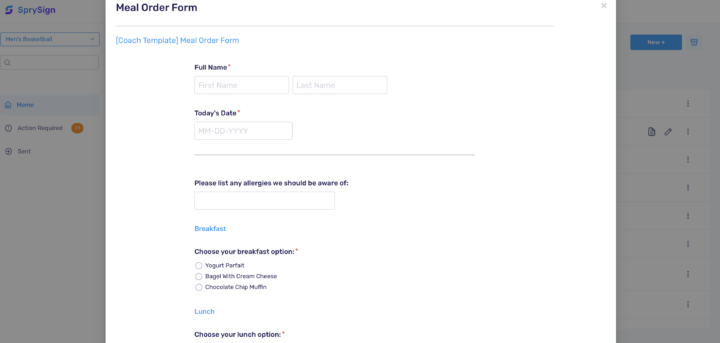
Yet again, SprySign makes this process incredibly easy. In your coach’s portal, you have the ability to customize meal order forms and send them directly to your student athletes. Once your student athletes complete the form you can compile the information and send it to the restaurant ahead of time to ensure everything runs smoothly.


Screenshot at  PM


In order to confirm that teams are able to get hotel rooms, coaches are encouraged to reach out and book the hotel rooms as soon as they know their schedule. The general rule of thumb, especially for bigger teams, is the earlier the better when booking. However, I recommend reaching out to hotels the week of the road trip or the week prior to double check that the hotel has your rooms for the trip. The last thing you need after a late game or a long day of travel is to arrive at the hotel and find that your rooms aren’t available. If you have a Type A personality, you can create general itineraries and begin looking at the food options for the team months in advance, but it’s not necessary. Researching food options and ordering doesn’t need to be done until a few days prior to the trip. 

Travel trips don’t have to be stressful. Coaches should be able to focus on the competition at hand without worrying about whether every detail of the trip is in place. That’s why it’s so helpful to be prepared and take care of what you can early, like during the off-season, to reduce added stress once the season begins. Creating a checklist of reminders and items to bring can also help keep everything organized and ease your mind. Ultimately, the goal is to approach each trip focused on the competition, confident that everything else has already been taken care of.

Coaching at the collegiate level goes beyond just game strategy. This series explores the administrative side of running a successful program, with practical insights from Coach Mac, a former women’s volleyball coach.

Have a topic you’d like us to explore? We welcome and encourage you to reach out with suggestions for future sessions: [email protected]

Unofficial Visits

Campus visits are a big part of the recruiting journey for the university, coaches and prospective student-athletes (PSAs), or recruits. In Part 1 of this series, we discussed official visits. For some universities or programs, budgets and accessibility make it difficult to offer multiple official visits, which is why unofficial visits are offered as an alternative. Unofficial visits allow recruits to visit campus, but all costs are covered by the recruit/recruit’s family. This means that recruits are responsible for their own travel, whether that includes flights, transportation, a hotel stay (if needed), and most other expenses. However, there are a couple of things that a program is allowed to pay for or provide during an unofficial visit. 

Teams are allowed to provide complimentary admissions to a home contest for the recruit and their accompanying family members. The program is also allowed to provide meals for the recruit and accompanying family members. While a program can’t provide a hotel room or pay to house the recruit, it may provide a dorm room with a current student-athlete, as long as the recruit pays the institutional lodging rate.

A question you might have is whether you can hold a tryout for a recruit while they are on an unofficial visit. The answer is yes. 

Just like a tryout held during an official visit, several pieces of paperwork are required for compliance purposes. The requirements are as follows:

  • A physical completed within the last year and a sickle cell test result. 
  • Tryouts must take place after June 15 going into the recruit’s junior year.
  • Each recruit can only participate in one tryout per college, not one tryout per campus visit. 
  • All paperwork should be collected and turned into the college’s compliance director. 

Coaches are always encouraged to discuss any further specific requirements that they want prior to tryouts on either official or unofficial visits, including when all paperwork must be turned in. 

Visits are a key aspect in recruiting for coaches, programs and potential student-athletes. They give both coaches and recruits the opportunity to get to know one another and begin building a connection. Before that can happen, however, coaches must ensure all requirements are in place so there are no issues when the recruit arrives on campus. This includes any required paperwork from both the NCAA and the college compliance director. Coaches are encouraged to make sure to clearly communicate with their compliance director in order to ensure that everything gets in on time so that they and the recruit can enjoy the visit day. 

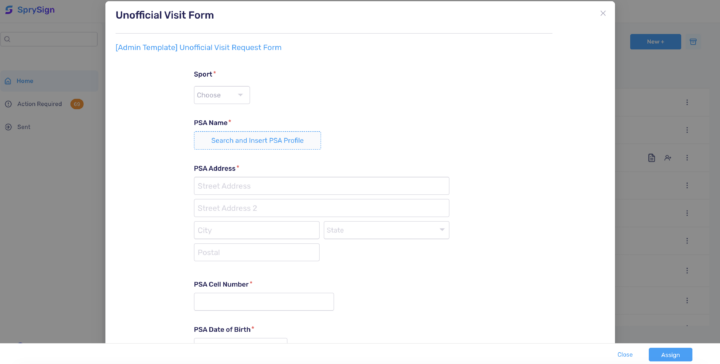
As mentioned in Part 1, SprySign is incredibly helpful for keeping these things organized. Similar to the Official Visit workflow, coaches also have the opportunity to submit required information through an Unofficial Visit workflow. This makes the process for both coaches and administrators much more seamless while providing the recruit with a valuable, end-to-end experience.


Screenshot at  AM


All information was fact checked using the 2025-2026 NCAA Division II Manual.

Coaching at the collegiate level goes far beyond game strategy. That’s why we’re excited to announce a new blog series that explores the administrative side of running a successful collegiate program. This series is written by Coach Mac—a former women’s volleyball coach—and aims to highlight key topics that coaches and administrators navigate each and every day. 

Have a topic you’d like us to explore? We welcome and encourage you to reach out with suggestions for future sessions: [email protected]

Part 1: Official Visits

There is so much that goes into collegiate coaching beyond coaching the skills of the game. If you were anything like me when I first started coaching, I was so overwhelmed with all the paperwork and administrative items that needed to be done for both the university and NCAA. Throughout this series, we are going to investigate some of those additional items that newer coaches may want to learn about or even for seasoned coaches that just want to learn more. First up, we are going to be diving into official visits. 

An official visit is any visit to a college or university by a PSA and their parents that is paid for by the college. The key point is that the college pays for the visit. This could look like a college paying for your travel to campus, whether it be gas or even a flight, a night stay at the local hotel, entertainment, or complimentary admission to a home match. The only prospective student-athletes (PSAs) who are able to take official visits are those who have reached June 15th following their sophomore year, entering their junior year. PSA’s are only allowed to come on one official visit per college. For some coaches, this might happen as the PSA’s first time on campus or it might be later on in the recruiting process with the PSA. This is entirely dependent on the coach, program, or department. No official visit can exceed 48 hours. The time clock does not include travel time and will begin as soon as the PSA arrives on campus. 

In order to comply with all NCAA requirements, there are multiple items that should be collected and returned to your college’s compliance director prior to the arrival of the PSA on campus. Each coach will need to make sure that the PSA is registered with the NCAA Eligibility Center. This might also include having the PSA placed on the program’s IRL. The NCAA Eligibility Center is a website that all PSA’s must sign up on to be cleared to begin competing in college sports. The eligibility process begins during the recruiting process, not just when the PSA arrives on campus for their first day as a student-athlete. Every coach will need to make sure that they get an academic transcript from the PSA as well. For visits, the transcript can be an unofficial transcript from the PSA’s high school and not an official one. Transcripts will allow all compliance directors to ensure that the PSA is on the right track to being eligible to compete when they begin college athletics. Coaches should check with their compliance director at their institution to know how much prior these items should be completed. The forms might look different college to college, so coaches should check with their department if there is any specific paperwork that needs to be completed for the department. However, if there is nothing specific that needs to be turned in, I have included an example form to help you as you begin recruiting your PSAs and bringing them on campus for an official visit. 

During some official visits, coaches may want to have the PSA’s tryout or play live. This would allow coaches to be able to see how the PSA plays with the team and/or moves on the court or field. While this sounds like a great opportunity for both the PSA and coaches, there is additional paperwork that must be included in the official visit form such as, a physical and sickle cell test result. Similar to the requirements for official visits, tryouts must be after June 15th going into the PSA’s junior year and a PSA can only participate in one tryout per college. The physical must be completed within one year prior to the tryout date. Both of these items would be turned into the compliance director and shared with the college’s athletic trainer. 

Recruiting is a very exciting time for both the PSA and coaches. With the excitement can come moments when we forget to stay in compliance with NCAA regulations. That’s why it’s important for coaches to stay organized and prepare sooner rather than later, giving the PSA enough time to gather everything needed to fully enjoy their visit to campus. 

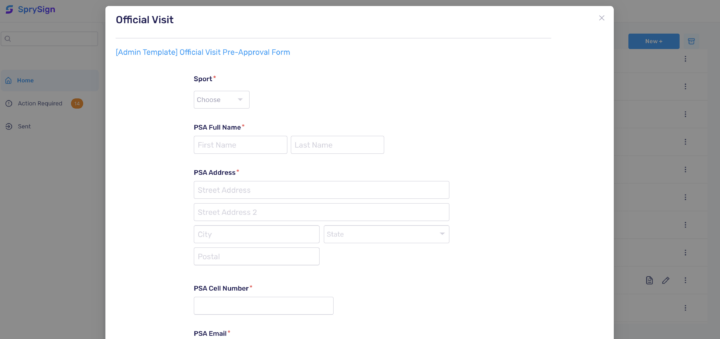
One way to keep all of this organized is by using SprySign, which allows coaches to submit everything they need through an Official Visit workflow. Instead of juggling multiple forms and emails, it puts all the required information in one place so your administrative staff has what they need to process the visit and keep everything compliant.


SprySign Official Visit Form


All information was fact checked using the 2025-2026 NCAA Division II Manual.

From SMSU Athletics

MARSHALL, Minn. – Southwest Minnesota State University has announced a new partnership with Spry, an industry-leading, all-in-one athletics management platform, providing the university with a comprehensive solution to enhance operational efficiency, compliance, and student-athlete engagement across its athletics department.

Through this partnership, SMSU will strengthen and modernize its athletic operations by leveraging a centralized platform, bringing recruiting, compliance, communication, paperwork, and roster management together in one intuitive system. Spry was built to help institutions centralize and streamline key administrative functions across its athletic programs, giving staff a more unified and efficient way to manage day-to-day responsibilities.

As a result, SMSU will save valuable staff time, reduce administrative costs, and operate with greater clarity and control, ultimately enabling the athletic department to dedicate more resources and attention to enhancing the student-athlete experience and driving competitive success.

“We are thrilled to partner with Southwest Minnesota State University,” said Lyle Adams, CEO of Spry. “SMSU has a strong commitment to their student-athletes, and we believe the Spry platform will be an invaluable asset in helping them achieve new levels of operational excellence and institutional alignment. This partnership underscores the growing need for integrated software solutions in collegiate athletics, and we look forward to supporting SMSU’s mission for years to come.”

“As we looked for ways to be innovative in how we operate, Spry stood out for its design and commitment to customer success,” said Travis Whipple, Vice President of Athletics. “We want tools that are built for institutions like ours, and Spry has demonstrated that commitment. Their platform will help us increase efficiency, reduce administrative friction, and ultimately better support our student-athletes, coaches, and staff.”

The implementation is underway, with full adoption planned before the start of the next academic year. Both organizations anticipate that the digital transformation facilitated by Spry will set a new standard for efficiency and strategic management within the Northern Sun Intercollegiate Conference.

COLUMBIA, S.C. — Benedict College Athletics is thrilled to announce the extension of its partnership with Spry, an athletic department management platform that aims to enhance and streamline internal processes.

“Spry truly listens to our needs and works alongside us as a partner,” said Theresa Laurante, Director of Compliance for Benedict College. “Their team is responsive, collaborative, and committed to helping us grow. As our department evolves, Spry continues to adapt with us, ensuring we have the tools and support necessary to operate at a high level and better serve our student-athletes.”

Benedict will continue to use Spry to enhance communication among coaches, staff, and athletes. With Spry’s large-scale messaging capabilities and eligibility management functions, Benedict’s athletic department will be able to streamline communication and make critical information accessible to all stakeholders in real time. Capitalizing on all Spry’s functions will facilitate Benedict Athletics to improve its efficiency and provide higher visibility for the student-athletes.

“We are excited about extending our partnership with Benedict College Athletics,” says Lyle Adams, CEO of Spry. “Their dedication to excellence resonates with our core values. We look forward to further collaborating with Athletic Director Willie Washington, and the entire Benedict College Athletics Department, to help them achieve new heights.”

About Benedict Athletics:
Benedict College fields 16 NCAA Division II teams, competing in baseball, men’s and women’s basketball, men’s and women’s cross country, football, softball, men’s and women’s tennis, men’s and women’s indoor track and field, men’s and women’s outdoor track and field, and men’s and women’s volleyball. Benedict is a member of the Southern Intercollegiate Athletic Conference, the nation’s second-oldest HBCU athletic conference with more than 120 years of storied excellence. Benedict has won the SIAC Commissioner’s Cup, presented to the school with the top overall athletic program, determined by team finishes in conference championships and tournaments, for men’s sports in 2014, 2015, 2016, 2022, 2023, and 2024, and for women’s sports in 2015, 2016, 2017, 2022 and 2023. From the start of the 2013 school year, Benedict has won 33 SIAC championships, more than any other school in the league.

About Benedict College:
Founded in 1870 by a woman, Bathsheba A. Benedict, Benedict College is a private co-educational liberal arts institution offering 29 competitive baccalaureate degree programs and two master’s degree programs. The Midlands HBCU welcomes students from several counties in South Carolina, states across America, and countries around the world. The College also has a diverse faculty deeply engaged in teaching, research, and service.

Benedict College has been highly regarded and exceptionally ranked for its programs by several academic and traditional publications.  Benedict College is the recipient of the 2024 UNCF Institutional Excellence Award given by UNCF’s Institute for Capacity Building Program in celebration of an HBCU that achieved next-level performance. Benedict was also named HBCU of the Year by HBCU Digest and voted the number one Gold Winner in The States’ BEST College or University in 2025.

Benedict College is accredited by the Southern Association of Colleges and Schools Commission on Colleges to award baccalaureate and master’s degrees. Five of the College’s degree programs hold national accreditation: Social Work Program, Environmental Health Science Program, Environmental Engineering, Studio Art, and the Tyrone Adam Burroughs School of Business and Entrepreneurship.